

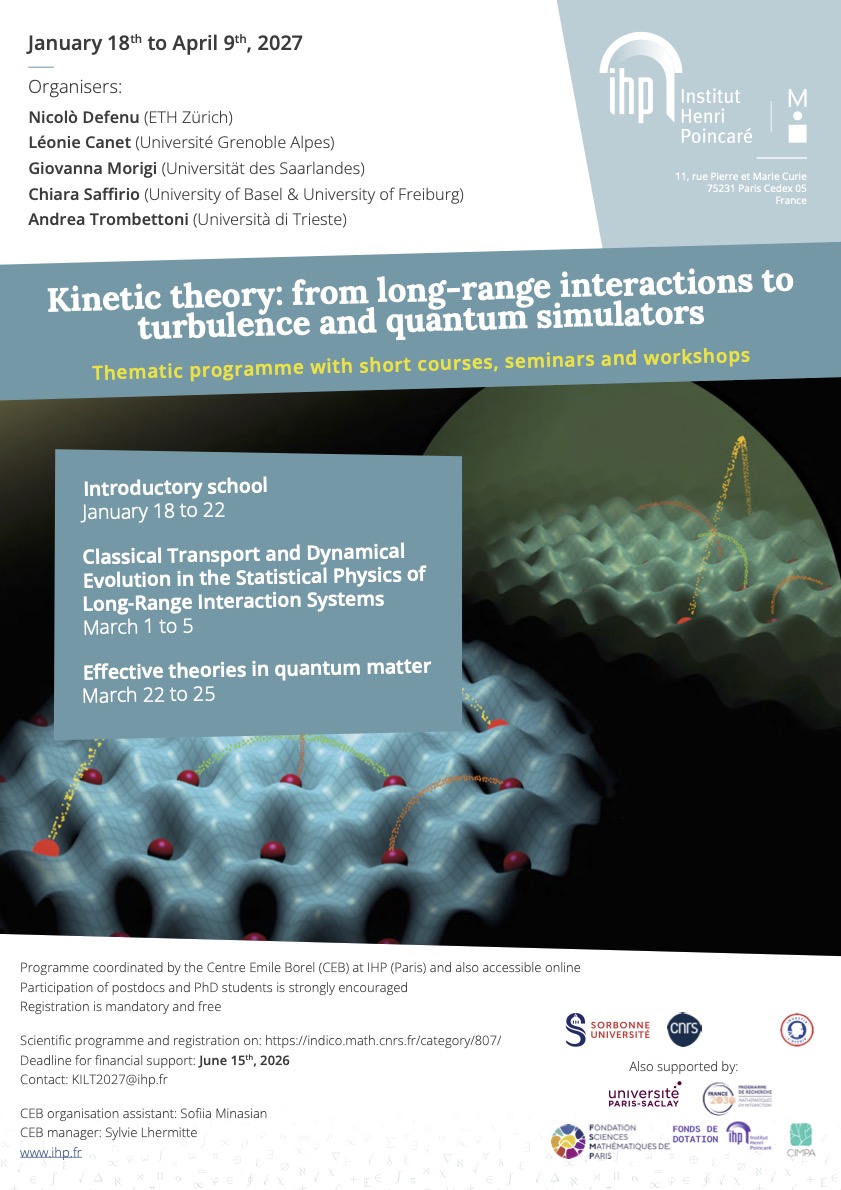
The program centers on the development of a unified understanding of kinetic theory in systems with long‑range interactions, with a particular emphasis on the quantum regime. Long‑range interacting quantum systems—realized experimentally in cold atoms, trapped ions, and polar molecules—exhibit rich dynamical behavior such as metastability, collisionless dynamics, anomalous transport, critical scaling, and turbulence‑like phenomena. These effects are often linked to the Vlasov equation, the collisionless kinetic equation that emerges in the thermodynamic limit. While Vlasov theory is conceptually well established in classical plasma physics, its systematic extension to quantum many‑body systems remains incomplete.
A key scientific motivation of the program is that different communities—mathematical physics, quantum many‑body theory, and AMO physics—address similar non‑equilibrium long‑range phenomena using different methods, preventing the emergence of a unified framework. The program aims to bridge these approaches and clarify conceptual connections between classical and quantum kinetic theories.
The scientific agenda spans several interconnected themes. One major theme is the analysis of classical transport, Vlasov dynamics, and their differences from Boltzmann kinetic theory, including how turbulence, chaos, and long‑range correlations emerge in classical systems. Another theme concerns the quantum generalizations of Vlasov theory, focusing on rigorous derivations and effective equations for quantum gases, including mean‑field and Gross–Pitaevskii limits, and the treatment of finite‑size effects in quantum simulators.
The program will explore non‑equilibrium many‑body dynamics in quantum systems, including quantum turbulence, cascade processes, ergodicity breaking, and anomalous scaling. A related line of inquiry concerns the dynamics of quantum correlations and entanglement, the onset of quantum chaos, and the characterization of universal quasi‑static dynamics in isolated systems. Another scientific direction is the study of effective theories in quantum matter, connecting renormalisation‑group methods with kinetic descriptions and identifying the regimes where classical scaling concepts can illuminate quantum behavior.
On the mathematical side, the program emphasizes rigorous derivations of macroscopic equationsfrom microscopic many‑body dynamics, particularly in long‑range systems, and the formulation of effective transport equations, scaling limits, and mean‑field theories. Renormalisation‑group tools are highlighted both in their rigorous and approximate forms, with the aim of connecting microscopic models to emergent large‑scale behavior in many‑body systems.
Finally, the proposal identifies a scientific need to synthesize current insights into a coherent and predictive quantum kinetic theory for long‑range interactions, and to outline a roadmap of open problems invol
Timeline for the trimester:
January 18 to 22 - Introductory school
March 1 to 5 - Workshop 1 at IHP, Paris: Classical Transport and Dynamical Evolution in the Statistical Physics of Long-Range Interaction Systems
March 22 to 25 - Workshop 2 at IHP, Paris: Effective theories in quantum matter