

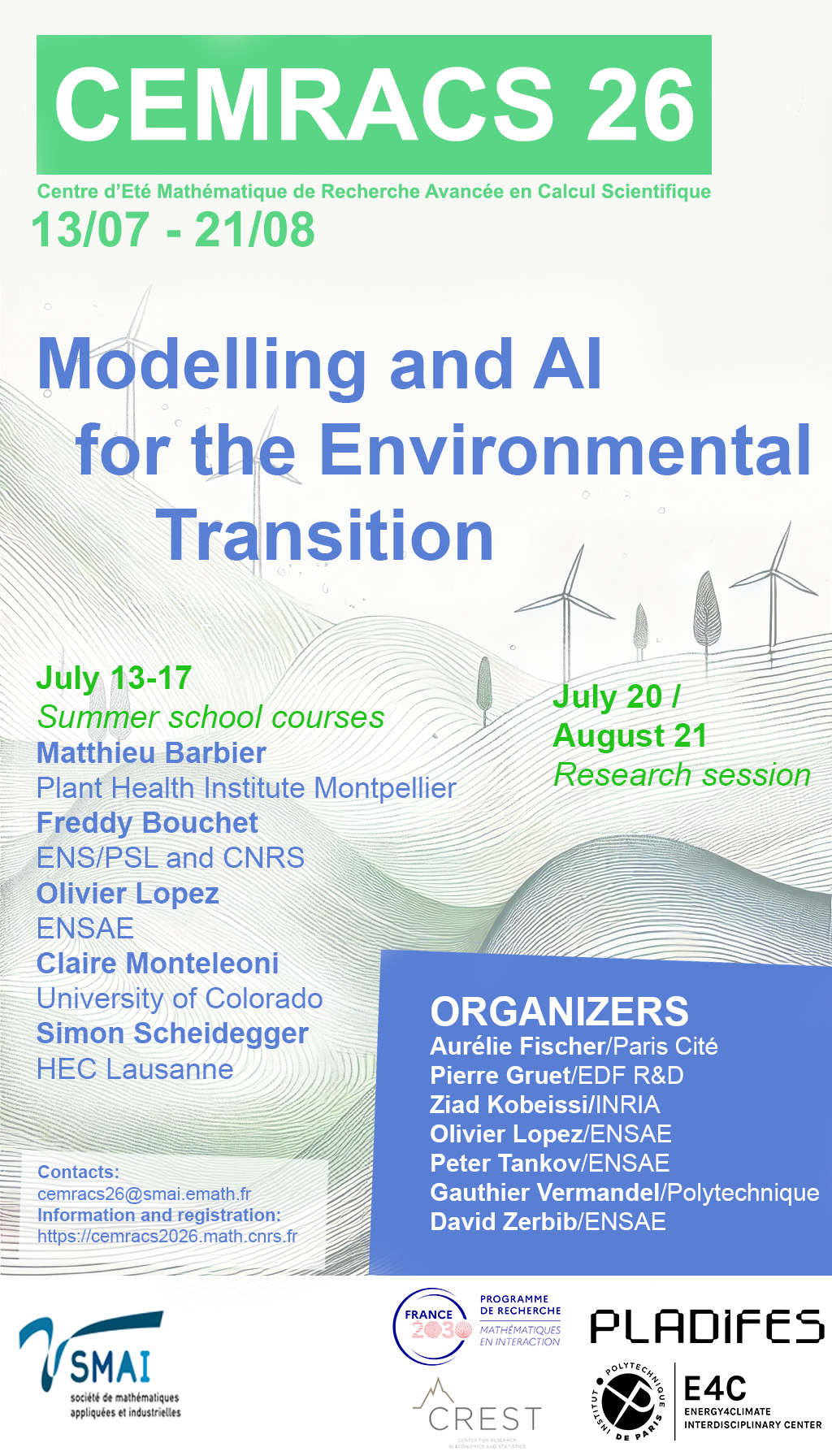
Modelling and AI for the Environmental Transition
Program
The principle of this event, organised by SMAI (Société de Mathématiques Appliquées et Industrielles) relies on strong industrial partnerships and has a two-period structure: the first phase consists of one week of lectures (July 15 to 19), and the second of a five-week period of project-based research. During the second phase, each participant works in a team on a collaborative research project proposed either by an industrial company or an academic team. Teams are made up of 2 or 3 young researchers, supervised by one or two experienced researchers provided by the company or academic team which proposed the project. The program includes:
- 1 week summer school (July 13-17)
- 5 weeks Hackathon / Projects on projects proposed by academic scientists and/or industrial partners (July 20 – August 21)
Topics
The urgency and complexity of the climate crisis call for contributions from many scientific domains, and the modelling challenges posed by the environmental transition call for inter- and transdisciplinary approaches, based on a multitude of data sources. At the same time, recent developments in climate science, climate economics, ecology, and other sciences dealing with environmental transition require stronger interactions of these disciplines with applied mathematics and data science to develop new models for simulating realistic scenarios, making predictions, and anticipating and controling risks.
The CEMRACS 2026 will be an interdisciplinary event, focused on mathematical, statistical, financial, actuarial, and economic modeling for the environmental transition, with a specific focus on the following domains:
- Environmental and climate economics
- Climate change adaptation and mitigation
- Insurance and reinsurance
- Energy economics and finance
- Green finance, climate-related physical and transition risks
- Ecology, biodiversity dynamics, agriculture, fisheries
- Water management
- Climate science
Summer school
This summer school focused on the bascis of quantum computer applied to various fields in sientific computation and cryptography. it aims to provide a basis knowledge for the participants that will remain on the next 5 weeks working on dedicated projects. The typical work day will consist in four one-hour-and-a-half sessions, starting at 9am, 10:45am, 2pm and 4pm. The last session may last for two hours if necessary. Each slot will be dedicated either to a classical lecture, a shorter presentation or to a computational practice session.